This post contains affiliate links. If you purchase through a link, I may earn a small commission at no extra cost to you. Full disclosure here.
There’s a version of travel planning that looks like researching museums and finding the best restaurants. My version of travel planning includes all of that — and also figuring out where the nearest pharmacy is, whether the hotel is close to food I can actually eat, and making sure I have enough medication to cover a bad day plus a few extra.
I have IBS. It’s been part of every trip I’ve taken, and at this point it’s just part of how I travel. Most of the time it’s manageable. Sometimes it isn’t. The Scotland trip where I ate the wrong thing on the plane and spent an entire day unable to leave my hotel room was a hard reset on how seriously I take the planning side of this.
Here’s what I actually research before I book — and what I keep in my bag so a bad day stays a bad day instead of becoming a ruined trip.
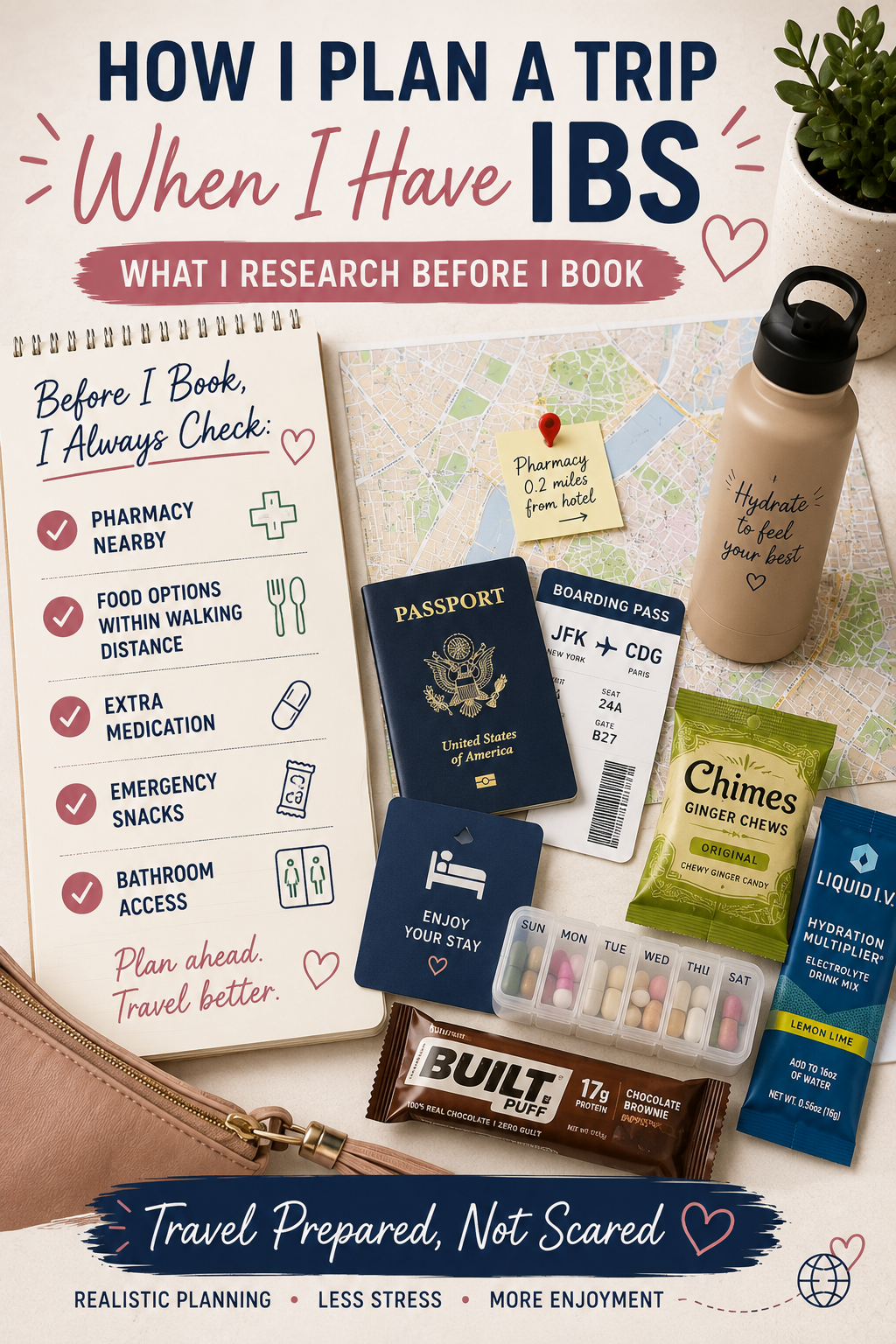
Before I Book: What I’m Actually Looking At
Hotel location relative to food options
This is the first thing I check, before reviews, before price, before amenities. I need to know what’s walkable from the hotel when I’m not feeling well enough to go far.
A great hotel in a location where the nearest food is a 20-minute walk or a taxi ride is a problem for me on a flare day. I’m looking for somewhere with easy access to a grocery store, a café, or somewhere I can get something plain and simple without it being a production. Markets and supermarkets are actually ideal — I can get crackers, fruit, rice-based things, whatever I need without navigating a restaurant menu when I’m already not feeling well.
I also check whether there’s a kettle in the room. It sounds minor. It matters more than I’d like to admit on bad mornings.
Pharmacy access
Before every trip I look up where the nearest pharmacy is to my hotel and note the hours. In Europe this is usually straightforward — pharmacies are common, well-stocked, and the staff are often more knowledgeable and willing to help than you’d expect. In some countries pharmacists can advise and recommend without a prescription for things that would require one at home.
I note whether it’s a chain or independent, what the hours are, and whether it’s open on Sundays. I’ve never had to use this information in an emergency, but having it means I’m not Googling “pharmacy near me” in a foreign city while already anxious and unwell.
Bathroom access at the places I want to visit
I quietly check this before major sightseeing days. Most major tourist sites in Europe have facilities, but knowing in advance — and knowing where they are when I arrive — is different from hoping they exist. I do a quick scan when I first get to a location and note the exits and bathrooms before I settle into enjoying it. It takes about two minutes and it makes a significant difference to how relaxed I can be for the rest of the visit.
Before I Fly: Medication and Supplies
I always bring more medication than I think I’ll need. Not slightly more — significantly more. Enough for the trip, plus a buffer for delays, plus extra for a genuinely bad stretch. Running out of anti-diarrheal medication in a foreign country when you need it is not a situation I’m willing to be in.
Everything goes in my carry-on. Not my checked bag, not my suitcase — my personal item, with me on the plane. If anything ever gets lost or delayed it will not be my medication.
My travel medication kit includes: anti-diarrheal (Imodium or equivalent), antacids, whatever prescription medications I take regularly, Chimes Ginger Chews for nausea and general stomach settling, and MQ Motion Sickness Patches because turbulence and motion on top of an already unsettled stomach is its own category of miserable.
I also keep a travel pill organizer so everything is sorted and I’m not digging through a bag for a specific bottle when I need it quickly.
The Plane Food Problem
The Scotland trip taught me this the hard way: plane food is unpredictable, and for someone with IBS, unpredictable food at 35,000 feet with no exit option is a real risk.
I now eat very lightly before and during flights. If there’s meal service I’ll check what’s being served in advance where I can, but mostly I default to bringing my own food and treating the plane meal as optional rather than expected.
What I bring: BUILT Bar Puff Protein Bars are my go-to because they’re light enough to eat when I’m not fully hungry but substantial enough to count as a meal if I need them to. Crackers, trail mix, and something plain and easy round it out. I also add a Liquid I.V. packet to my water bottle after boarding — staying hydrated is genuinely protective on flights, and IBS symptoms tend to be worse when I’m dehydrated.
The goal isn’t to have a great meal on the plane. It’s to land feeling okay.
On the Ground: Eating in a Way That Actually Works
Small meals throughout the day
This is the single most effective thing I do. On busy sightseeing days — especially in heat, especially when I’m walking a lot — eating one or two large meals is a reliable way to end up feeling terrible by afternoon. Small amounts of food more frequently keeps my system stable in a way that nothing else really does.
This requires a bit of planning because it means having snacks accessible rather than waiting until I’m hungry and then finding somewhere to eat. I keep something in my bag at all times: protein bars, crackers, whatever I picked up at the grocery store that morning. It’s not about eating constantly — it’s about never arriving at a meal completely empty and never eating until I’m uncomfortably full.
Knowing what to order before I get to the table
I check menus online before I go somewhere. Not always, not obsessively — but for a restaurant I’m genuinely excited about or somewhere where I know the options might be limited, I look at the menu in advance so I already know what I’m ordering when I sit down. This removes the stress of scanning a menu in a busy restaurant while the table is looking at me and I’m trying to figure out what’s safe.
I also look for grain and rice-based dishes, simple proteins, and things that aren’t heavily sauced or fried. Most cuisines have options that work — it’s just easier to find them when you’re not doing it under pressure.
Finding a “safe” place near the hotel
Within the first day of arriving somewhere, I find one reliable nearby option where I know what I can eat. A café, a grocery store, a simple restaurant. This becomes my backup for days when I’m not feeling adventurous with food — when I’d rather have something predictable than deal with the uncertainty of somewhere new. Having that option removes a lot of anxiety from the rest of the trip.
Traveling With People Who Know
I usually travel with family, which makes this easier in one specific way: they know, they don’t make it a big deal, and I don’t have to explain or manage anyone else’s reaction on a bad day.
If you’re traveling with someone who doesn’t know, I’d generally advocate for telling them. Not because you owe anyone your medical history, but because a bad day is significantly harder to navigate when you’re also managing someone else’s confusion about why plans are changing. Telling people in advance also means you can build in flexibility without it feeling like a problem — a slower morning, a change of restaurant, an afternoon back at the hotel — because it’s been framed as part of how the trip works rather than a last-minute disruption.
What I Keep in My Day Bag
Every single day, regardless of how I’m feeling when I leave the hotel:
- Anti-diarrheal medication
- Antacids
- Ginger chews
- A snack (protein bar or crackers)
- A small water bottle with a Liquid I.V. packet
- An extra pair of underwear
That last item is the one most IBS travel guides won’t mention, and it’s the most practical thing on the list. A bad flare day sometimes escalates faster than expected, and having a spare means a difficult hour doesn’t have to become a ruined day. It takes up no space. It provides an outsized amount of peace of mind. If you have IBS and you’re not already doing this, start.
The Mindset Shift That Actually Helps
The Scotland day was genuinely terrible. I was sick, I was frustrated, I was upset about losing a day of a trip I’d been looking forward to. And then — nothing catastrophic happened. The trip continued. I felt better the next morning. We adjusted the plan and moved on.
IBS is unpredictable, which means some trips will have a bad day in them no matter how well I’ve planned. The planning isn’t about guaranteeing that nothing goes wrong. It’s about reducing the variables I can control so that when something does go wrong, it’s easier to manage and faster to recover from.
That’s the version of travel that works for me. Not avoiding trips because something might happen — but going, prepared, with the realistic expectation that most days will be fine and the occasional hard one is survivable.
As an Amazon Associate, I earn from qualifying purchases. See my full Affiliate Disclosure for details.
 Practical Cozy Travel